When this happens, councils across the country are required to update their websites as part of a set of official protocols known collectively as Operation Bridge. This applies to parish, town, and other local councils, and the expected actions are broadly the same each time.
Every council website we build now includes a purpose-built Operation Bridge tool as standard, at no extra cost. Here’s what the protocol requires, and how our plugin handles it.
What is Operation Bridge?
“Operation Bridge” is the umbrella term used across local government for the family of official protocols that get triggered by the death of a senior royal. Each one has its own codename – Operation London Bridge covered the death of Queen Elizabeth II, Operation Forth Bridge covered Prince Philip, Operation Menai Bridge covers King Charles III but councils typically bundle them into a single internal policy, since the actions required are broadly the same regardless of which member of the Royal Family it applies to.
These plans only ever activate once there’s a formal, official announcement – never on early news reports or social media speculation.
What councils are expected to do on their website
Once an announcement is confirmed, councils are expected to move quickly. The standard guidance covers a few key things:
- Put up a “mourning mode” holding page as the main entry point to the site – typically a black background, a photo, and the person’s dates.
- Publish a message of condolence from the council, signed off by the Clerk and Chair.
- Add a link to a Book of Condolence, along with any relevant local details – service times, minute’s silence, funeral broadcast information.
- Pause non-essential content – scheduled news posts, routine updates, anything upbeat or promotional.
- Keep essential council business reachable underneath the holding page, since statutory notices and services still need to function.
- Take the holding page down again once the mourning period officially ends, typically the morning after the funeral.
None of this is complicated in principle. The difficulty is timing – this all needs to happen within hours of a confirmed announcement, which is a genuinely difficult thing to build from scratch under pressure, on a day when your Clerk and councillors have a great deal else on their minds.
How our plugin handles it
Every council website we build now includes our own Operation Bridge tool, built directly into the site. It’s simple by design:
- Set it up once, in advance. Upload a photo, add a name/title, and add the year(s) of birth and death – all from a straightforward settings page in WordPress. No developer needed.
- Leave it switched off. It sits dormant, doing nothing, until it’s needed.
- Flip one switch when it’s needed. Tick “Enable” and save. The holding page appears for every visitor immediately – no waiting on us, no waiting on a developer, no rebuilding anything from scratch on the day.
- Each visitor sees it once. After that, they can carry on to the rest of the site as normal for the remainder of their visit.
- Turn it off just as easily, once the mourning period has ended.
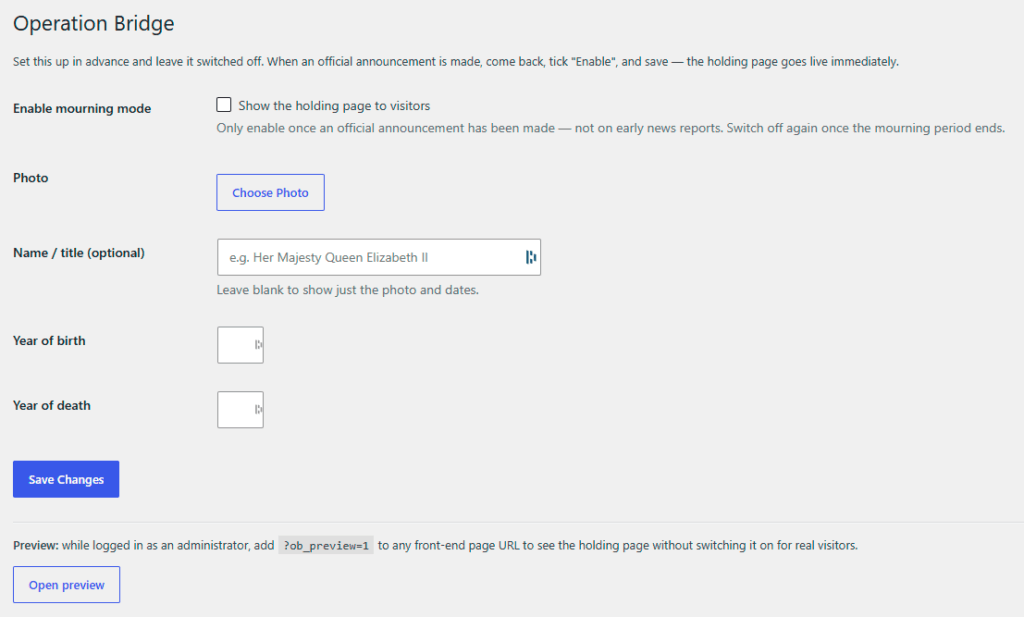
There’s also a quiet safe way to preview exactly how it’ll look before you ever need it for real – so nobody’s finding out what it looks like for the first time on the day it matters most.
Why we build this in as standard
We think a council website provider should be thinking about more than how a site looks day-to-day. Councils operate under a different set of expectations to a typical business – statutory obligations, public scrutiny, and moments like this one, where the right response is expected of you whether or not anyone’s had time to plan for it.
Building this in as standard, on every council site we deliver, means one less thing to worry about, and one thing you’ll never need to ask us to rush through under pressure.
If you’re a council currently reviewing your website – whether that’s a full redesign or just wondering what you’re currently missing – get in touch. This is one of a handful of things we build in without being asked, because we think it should be there.